
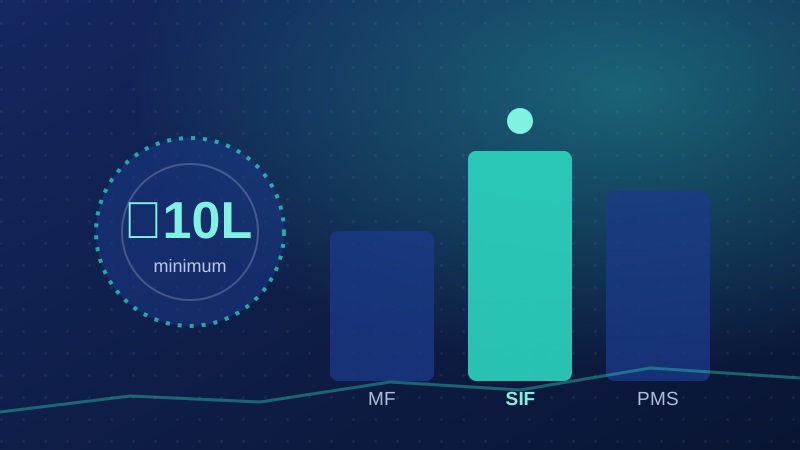
SIF — the Specialised Investment Fund — is the newest asset class in Indian investing, and it sits deliberately in the gap between a mutual fund and a PMS. It is not a product for everyone, and that is rather the point. Here is what it is, who it is built for, and the questions worth asking before you consider one.
What a SIF actually is
A Specialised Investment Fund is a pooled investment vehicle introduced by SEBI as a distinct category, sitting between mutual funds and Portfolio Management Services. Like a mutual fund, your money is pooled with other investors and managed by a professional fund manager under a regulated structure. Unlike a standard mutual fund, the strategies permitted are considerably wider.
The reasoning behind creating it is straightforward. Mutual funds are designed for mass retail participation, so their investment mandates are deliberately constrained. PMS requires a far larger commitment and gives you direct ownership of the securities. A large group of investors sat between those two poles — willing to accept more complexity and risk than a plain mutual fund allows, but without the capital or the appetite for a full PMS mandate.
SIF is the regulatory answer to that gap: a pooled, professionally managed structure with a higher entry threshold and a wider strategy toolkit than a conventional mutual fund scheme.
The entry threshold, and why it exists
The minimum investment in a SIF is ₹10 lakh, applied across the strategies you hold with a given provider. This is a regulatory threshold, not a marketing decision, and it cannot be waived.
The threshold is doing deliberate work. It is a filter, not a fee. By setting the minimum well above a typical mutual fund SIP, the regulator has restricted these strategies to investors for whom a ₹10 lakh commitment is a considered allocation rather than a substantial share of total net worth. If ₹10 lakh would represent most of what you have to invest, the structure is telling you something useful about whether it fits.
Where the extra flexibility comes from
The defining feature of a SIF is the breadth of what the manager is permitted to do. Strategies can be built around equity, debt or a hybrid of both, and managers have greater latitude in how they construct and hedge positions than a conventional mutual fund mandate allows.
That flexibility runs in both directions. A wider toolkit can help a skilled manager pursue returns that a constrained mandate could not, and it can also manage downside more actively. It equally means outcomes depend far more heavily on manager skill and judgement than in an index-tracking or tightly-mandated fund.
The practical consequence: with a SIF you are underwriting a manager and a process, not merely an asset class. Due diligence on the manager matters more here than it does with a plain-vanilla fund.
How SIF compares with what you already know
Against a mutual fund: SIF has a far higher minimum, a wider strategy mandate, and correspondingly greater dispersion in possible outcomes. A mutual fund lets you start with a few hundred rupees and offers daily liquidity in most open-ended schemes; a SIF asks for a serious commitment up front.
Against a PMS: SIF has a much lower entry point than the ₹50 lakh SEBI mandates for PMS, and your money is pooled rather than held as individual securities in your own demat account. PMS gives you direct ownership and a more customisable mandate; SIF gives you access to sophisticated strategies at a fraction of the commitment.
None of these is better in the abstract. They are different instruments for different balance sheets and different temperaments.
Who it genuinely suits — and who it does not
A SIF may deserve consideration if you already hold a well-built core portfolio, have surplus capital beyond your emergency fund and near-term goals, understand that sophisticated strategies can and do have poor years, and are investing for a genuinely long horizon.
It is very likely the wrong instrument if ₹10 lakh is a large share of your investable assets, if you might need that money within a few years, if you have not yet filled the basics — adequate insurance, an emergency fund, and goal-linked core investments — or if a sharp drawdown would push you to exit at the worst moment.
The honest position is that most investors are better served by getting their core allocation right before adding complexity at the edges. A SIF is an addition to a finished portfolio, not a substitute for building one.
Questions to ask before you commit
What exactly is this strategy trying to do, and in plain language? If it cannot be explained without jargon, that is information in itself.
What does the manager expect a bad year to look like, and what has actually happened in past stress periods? Anyone who cannot describe the downside has not thought hard enough about it.
What are the total costs, including every layer, and how do they compare against a simpler alternative that might achieve a similar outcome?
How and when can you exit, and what does that cost you? Liquidity terms vary and deserve reading properly, not skimming.
And the question underneath all of them: what specific job is this doing in my portfolio that nothing I already own can do?
Key takeaways
- SIF is a SEBI-defined asset class sitting between mutual funds and PMS
- Minimum investment is ₹10 lakh — a regulatory filter, not a fee
- Wider strategy mandate means manager skill matters far more
- Lower entry than PMS, but pooled rather than directly owned
- Suits surplus capital on top of a completed core portfolio
- Understand the downside, the costs and the exit terms before committing
This article is for general information only and is not financial advice. Mutual fund and market-linked investments carry risk. Please consult a qualified financial professional for guidance specific to you.