Investing in India from abroad is entirely straightforward once you understand three things: which account your money sits in, what gets deducted before it reaches you, and what it takes to send it back out. Get those right at the start and the rest is ordinary investing. Get them wrong and you spend years untangling paperwork.
NRE and NRO — the distinction everything rests on
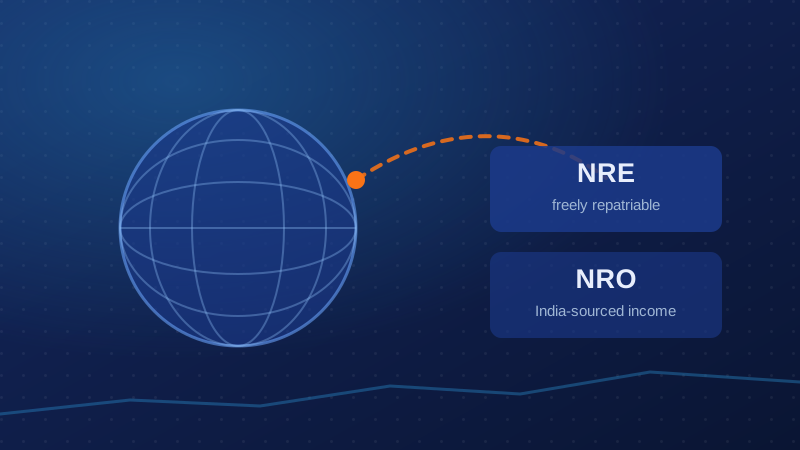
An NRE (Non-Resident External) account holds money you have earned abroad and remitted to India. The balance and the interest are freely repatriable, meaning you can send them back out without a ceiling, and NRE interest is generally exempt from Indian income tax.
An NRO (Non-Resident Ordinary) account holds income arising in India — rent from a property, dividends, pension, or the proceeds of assets you owned before moving abroad. NRO interest is taxable in India, and repatriation from an NRO account is subject to an annual limit and a documentation process.
The practical rule is simple: keep foreign earnings in NRE and India-sourced income in NRO, and do not mix them. Investments made from an NRE account retain a clean repatriable trail; those funded from NRO do not. Sorting this out at the outset costs nothing. Reconstructing it years later, when you want to move money out, is genuinely painful.
Getting the KYC right the first time
Your KYC has to reflect your non-resident status. Continuing to invest on a resident KYC after you have moved abroad creates a mismatch that surfaces at the worst possible time — usually when you try to redeem or repatriate.
You will typically need your passport, visa or proof of residence abroad, overseas address proof, PAN and recent photographs, with attestation requirements that vary by provider and jurisdiction. Update your status with your bank, the KRA and the fund houses.
One more thing worth doing at the same time: register your nominations properly. Cross-border succession without clear nomination is a slow and expensive problem to leave behind.
FATCA, CRS and why you are asked so much
India participates in international tax-information frameworks — FATCA for US persons and the Common Reporting Standard more broadly. In practice this means you will be asked to declare your tax residency and provide a tax identification number for the country where you are resident.
This is a routine declaration, not a red flag, and it applies to essentially every cross-border investor. Complete it accurately and keep it current when you change countries. An out-of-date declaration can cause accounts to be frozen for reporting reasons, which is an avoidable irritation.
Investors who are US or Canada residents should note separately that some Indian fund houses restrict or decline investments from those jurisdictions for their own compliance reasons. It varies by AMC, so check before you plan around a specific fund.
Tax deducted at source — the part that surprises people
The single biggest practical difference for NRI investors is TDS. Where a resident investor typically receives redemption proceeds in full and settles tax later, an NRI generally has tax deducted at source before the money reaches them.
This is not an extra tax. It is the same liability collected earlier, and where too much has been deducted it is recoverable by filing an Indian return. But it does mean the amount landing in your account will be lower than a resident would see on the identical investment, and you should plan your cash flows accordingly.
Rates differ by asset class and holding period and have been revised in recent years, so confirm the current position for your specific investment rather than relying on a figure you remember. If your country has a Double Taxation Avoidance Agreement with India, you may be able to claim relief so the same income is not effectively taxed twice — this usually requires a Tax Residency Certificate from your country of residence.
Repatriation — planning the exit at the entry
Money invested from an NRE account, in repatriable mode, can generally be sent back abroad without a ceiling. Money routed through NRO is subject to an annual limit and requires certification from a chartered accountant in the prescribed form.
The lesson is to decide the route before you invest, not when you want the money out. If there is a reasonable chance you will want these funds outside India one day, fund the investment from NRE and keep the documentation trail intact from day one.
Keep records of the original remittance, the investment, and the account it came from. Years later, that paper trail is what makes repatriation a form-filling exercise rather than an investigation.
Building the portfolio itself
Once the structure is right, the investing principles are the same as for anyone else: attach each investment to a goal and a timeline, get the asset allocation right before selecting funds, diversify sensibly and rebalance periodically.
The two considerations genuinely specific to NRIs are currency and horizon. If you intend to return to India, your future liabilities are in rupees and rupee assets match them naturally. If you intend to settle abroad permanently, think carefully about how much India exposure is appropriate and what exchange-rate movement does to a return measured in your home currency.
GIFT City has also opened up structures worth understanding for internationally mobile investors, with a different regulatory and tax treatment from ordinary domestic investment. Whether it fits depends on your residency and goals.
Key takeaways
- NRE for foreign earnings, NRO for India-sourced income — never mix them
- Update KYC to non-resident status before you invest, not after
- FATCA/CRS declarations are routine — keep them accurate and current
- Expect TDS on redemption; it is recoverable, but plan cash flows for it
- Decide the repatriation route before investing and keep the paper trail
- A DTAA and a Tax Residency Certificate may prevent double taxation
This article is for general information only and is not financial advice. Mutual fund and market-linked investments carry risk. Please consult a qualified financial professional for guidance specific to you.